
The Silent Tax Built Into Every Football Bet You Place
Most punters in football betting Kenya focus on picking the right outcome. They analyze form, study head-to-head records, watch injury updates — and then lose consistently anyway. One of the most significant reasons has nothing to do with their selections. It sits in the odds themselves, before a single ball is kicked.
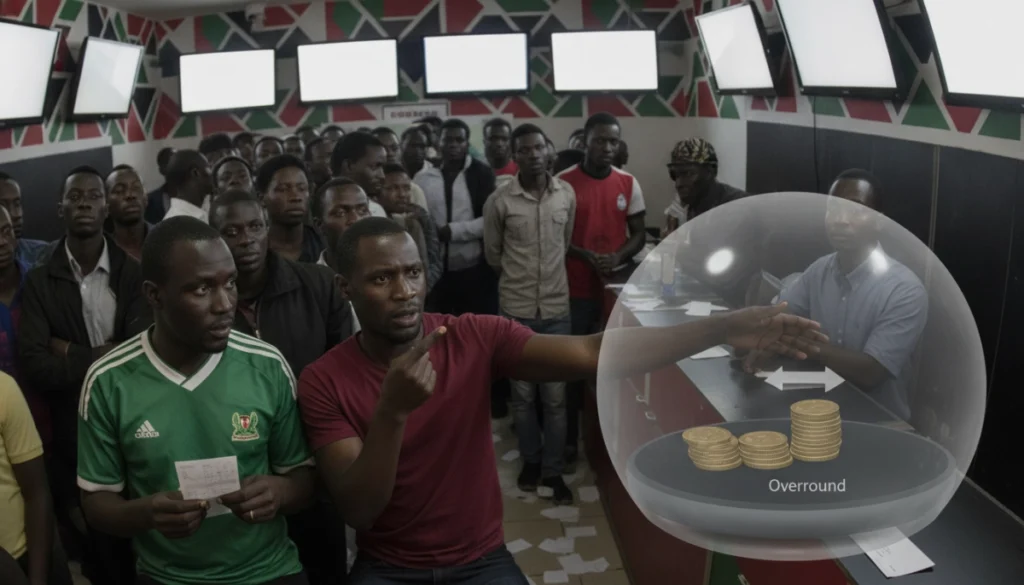
Bookmakers do not offer fair odds. What they offer are odds that reflect a slightly distorted version of true probability — skewed just enough to guarantee a mathematical edge for the house on every market they open. That built-in edge is called the overround, and understanding it changes how a punter reads any odds board.
What Overround Actually Means in Numerical Terms
In a genuinely fair market, the implied probabilities of all possible outcomes would add up to exactly 100%. If a match had a true 40% chance of a home win, 30% chance of a draw, and 30% chance of an away win, a fair bookmaker would price those outcomes so they sum to 100. That bookmaker does not exist.
In practice, those same outcomes might be priced to imply 44% + 33% + 33%, summing to 110%. That extra 10% is the overround — sometimes called the vig or juice — representing the bookmaker’s guaranteed margin regardless of what happens. Every percentage point above 100 is a silent tax deducted from the punter’s expected return before the match even starts.
To calculate overround manually, convert each set of odds to an implied probability: divide 1 by the decimal odds, then add the results across all outcomes. A 1X2 market with odds of 2.10, 3.20, and 3.40 produces implied probabilities of roughly 47.6%, 31.3%, and 29.4% — a total of 108.3%, meaning an overround of 8.3%.
Why Overround Varies Significantly Across Markets
The 1X2 market — the most liquid in football — typically carries a lean overround because betting volume allows bookmakers to price it efficiently. The margin on a Premier League 1X2 might sit between 5% and 8% on a competitive platform.
Move into correct score markets, both teams to score, or first goalscorer bets, and that margin climbs steeply. Correct score markets routinely carry overrounds above 30% on some platforms. These markets are harder for casual punters to evaluate, meaning bookmakers face less pressure to sharpen their prices. The less efficient a market, the more margin gets embedded — and the more a punter surrenders simply by participating.
This matters because many Kenyan punters gravitate toward higher-odds markets precisely because they look attractive. A correct score of 2-1 priced at 8.00 feels exciting. But if the true probability suggests that outcome should be 10.00, the punter is receiving 80 cents of value for every shilling they should be getting. That gap compounds dramatically when these selections are combined into accumulators.
What Overround Costs a Kenyan Punter in Real Shillings Each Month
Percentages are abstract. A punter staring at an 8.3% overround does not feel it the way they feel a losing slip. But convert that margin into actual money across a realistic month of betting, and the picture sharpens considerably.
Consider a punter placing five bets per week at an average stake of 200 Kenyan shillings — roughly 4,000 shillings per month wagered. If the average overround across their chosen markets sits at 10%, the mathematical expectation means they are effectively returning 90 shillings for every 100 staked before skill or luck is factored in. Over a month, that represents approximately 400 shillings surrendered purely to bookmaker margin. Not to bad luck. Not to poor selections. To the structural mathematics of the market itself.
A punter staking 500 shillings per bet across the same volume in high-margin markets could be surrendering over 3,000 shillings per month to overround alone — extracted before a single result has been determined.
How Accumulators Multiply the Margin Problem
If overround on a single match feels manageable, accumulators expose how aggressively it compounds. When a punter combines multiple selections, the overround from each leg does not simply add — it multiplies. Each leg introduces its own margin, and those margins stack against the punter with every additional selection.
The mathematics is unforgiving. If each leg carries a 10% overround, a two-leg accumulator returns approximately 81% of fair value. A five-leg accumulator drops to roughly 59%. A ten-leg accumulator collapses below 35%. The house does not need to manipulate results. The overround, multiplied across each leg, does the work automatically.
The appeal of accumulators is understandable — potential returns are dramatic and tracking multiple matches is genuinely engaging. But the cost structure is significantly more punishing than single-match betting, and most punters absorb that cost without ever having it clearly named.
Where Kenyan Platforms Sit on the Overround Spectrum
On major Kenyan platforms, overrounds on top European league 1X2 markets broadly fall in the 7% to 12% range. The divergence becomes more pronounced in several areas:
- Local Kenyan Premier League matches, where lower liquidity and less efficient pricing often produce overrounds significantly higher than equivalent European fixtures
- Novelty and proposition markets, including player-specific bets and half-time combinations, where margins frequently exceed 20%
- In-play betting markets, where rapid odds shifts and the bookmaker’s informational advantage allow for wider embedded margins
- Same-game multis, where compounding multiple selections within a single match amplifies the overround well beyond what individual market figures suggest
A punter’s exposure to overround depends heavily on what they bet on, not just how much. Two punters staking identical amounts monthly can face dramatically different effective tax rates based solely on market preferences. Sticking to mainstream 1X2 markets on well-traded European fixtures is a meaningfully different mathematical environment than regularly engaging with correct scores, in-play props, or local league markets.
Betting Smarter Means Pricing the Market Before You Price the Match
The overround is not a conspiracy. It is simply the business model, applied consistently and mathematically to every market a bookmaker opens. The punter who understands this is better positioned than the majority who treat the odds board as a neutral reflection of probability rather than a commercially constructed one.
The practical adjustments are not complicated. Prioritise high-liquidity markets on well-traded fixtures where competitive pricing compresses margins. Treat correct score and proposition markets with the same scepticism you would apply to any product with a hidden markup. Approach accumulators with clear awareness that each additional leg multiplies the structural cost embedded in every selection you include.
Comparing odds across platforms before placing a bet is one of the simplest and most underused habits available to Kenyan punters. The difference between an overround of 7% and 12% on a single 1X2 market may feel negligible on one bet — across a full month of volume, that gap represents a meaningful difference in what the market extracts before your judgment even enters the equation. OddsPortal offers a straightforward way to compare prices across bookmakers on major football markets, making it a useful reference before committing to any significant stake.
None of this guarantees profit. The overround is one layer of the mathematical environment punters operate in — variance, selection quality, and discipline all shape outcomes alongside it. But of all the factors that determine what a punter returns over time, the bookmaker margin is the only one that is entirely fixed, entirely visible to those who know how to read it, and entirely avoidable in its worst forms by making deliberate choices about where and how to bet.
The punter who never considers overround is paying a tax they do not know exists. The one who understands it has at least chosen which rate they are willing to pay — and that is a more rational starting position than most people betting on football in Kenya today are working from.