
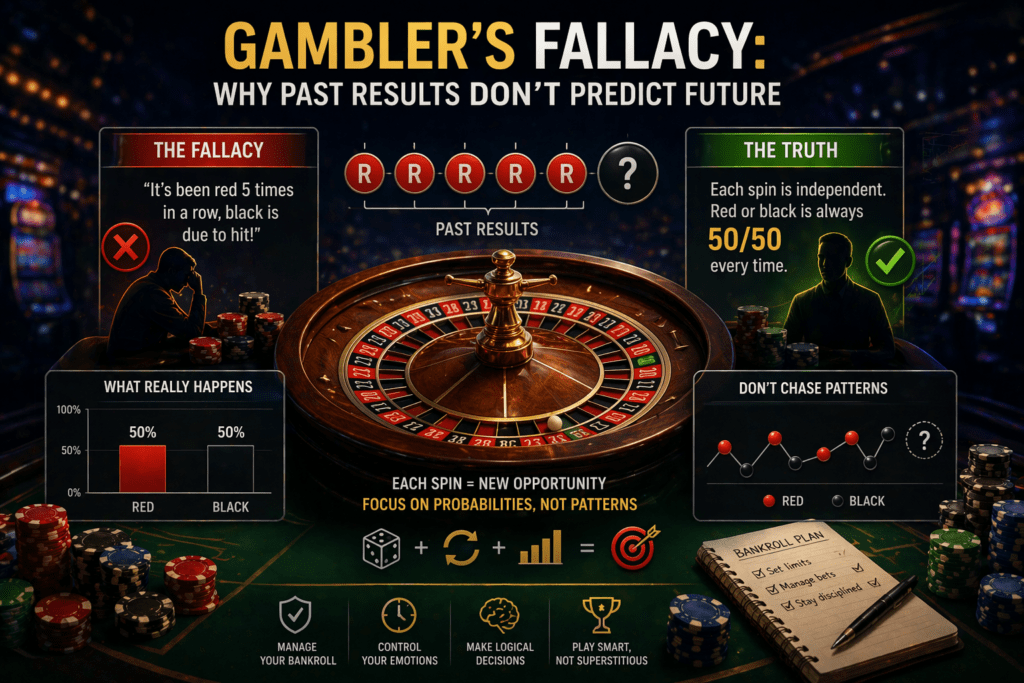
Understanding the Gambler’s Fallacy and why it tricks so many players
The Gambler’s Fallacy is one of the most common and costly mistakes in gambling. It is the belief that past outcomes influence future results in situations that are actually random and independent.
In simple terms, it’s the idea that “something is due to happen.”
For example:
- A roulette player sees red come up five times in a row and believes black is now more likely
- A bettor on a losing streak thinks a win is “around the corner”
- A slot player feels a machine is “ready to pay out”
In reality, none of these assumptions are true.
Each spin, hand, or bet is independent. The outcome does not “remember” what happened before. But despite this, the Gambler’s Fallacy remains deeply ingrained in how people think about probability.
Understanding this concept is crucial. Not just for avoiding mistakes, but for developing a rational approach to betting and gambling.
Why people believe past results matter
Pattern-seeking behavior
Humans are naturally wired to look for patterns. It’s a survival instinct. Our brains constantly try to make sense of the world by connecting events.
In everyday life, this is useful. But in gambling, it becomes a problem.
When we see:
- A sequence of reds in roulette
- A team losing multiple games
- A slot machine not paying out
our brain tries to detect a pattern where none exists.
This creates a false narrative that the sequence must “correct itself.”
Misunderstanding probability
Another key reason is a lack of understanding of probability.
People often believe that probabilities balance out in the short term. For example, if red and black are both close to 50%, they assume results should alternate frequently.
But probability doesn’t work like that.
Short-term results can vary wildly. Long streaks are not only possible, they are expected over time.
This misunderstanding fuels the Gambler’s Fallacy and leads to poor decision-making.
Real examples in casino and sports betting
Roulette and “due numbers”
Roulette is the classic example.
If red appears 10 times in a row, many players will start betting heavily on black, believing it is “due.”
However, the probability remains the same on every spin.
The wheel has no memory.
Losing streaks in sports betting
Sports bettors often fall into the same trap.
After several losses, they believe:
- “I’m due for a win”
- “My luck has to change”
This often leads to:
- Increasing bet size
- Taking unnecessary risks
- Chasing losses
But each bet is independent. Past losses do not increase the probability of winning the next bet.
The math behind independence of events
To understand why the Gambler’s Fallacy is wrong, you need to understand independent events.
An independent event means:
- The outcome is not affected by previous outcomes
For example, in roulette:
- Probability of red is roughly 48.6% (European wheel)
- This does not change after any number of spins
Even after 20 reds in a row, the next spin is still:
- 48.6% red
- 48.6% black
- 2.7% green
The same applies to:
- Slot machines (RNG-based)
- Card shuffling (in most online formats)
- Many betting markets
The key idea is simple: probability resets every time.
Why the fallacy is so dangerous
The Gambler’s Fallacy doesn’t just lead to small mistakes. It can seriously damage your bankroll.
Main risks include:
- Chasing losses
- Increasing bet sizes irrationally
- Overconfidence after streaks
- Ignoring real value
It also creates emotional instability:
- Frustration when “due” results don’t happen
- False confidence when they do
This combination of emotional and mathematical error makes it one of the most dangerous biases in gambling.
How to avoid falling into this trap
Avoiding the Gambler’s Fallacy requires awareness and discipline.
Practical tips:
- Treat each bet independently
Focus only on current odds and value - Ignore streaks
They don’t predict future outcomes - Use bankroll management
Avoid increasing stakes based on emotions - Stick to strategy
Don’t adjust based on “feelings” - Understand probability basics
This is your best defense
The goal is to separate emotion from logic.
Conclusion: randomness doesn’t have memory
The Gambler’s Fallacy is powerful because it feels intuitive, but it is fundamentally wrong.
Random events do not have memory. They do not correct themselves. They do not “owe” you a win.
Once you truly understand this, your approach to gambling changes completely.
You stop chasing patterns and start focusing on value, probability, and discipline.
And that shift alone can make a huge difference in your long-term results.
FAQ
What is the Gambler’s Fallacy?
It is the belief that past outcomes influence future results in random events.
Why is it wrong?
Because each event is independent and probabilities reset every time.
Does a losing streak mean a win is coming?
No. Each bet has the same probability regardless of past results.
Is this common in gambling?
Yes, it is one of the most common mistakes among players.
How can I avoid it?
By understanding probability, ignoring streaks, and sticking to a disciplined strategy.
Does this apply to all casino games?
It applies to all games based on independent random outcomes, such as roulette and slots.