
Betting odds explained clearly and correctly are the foundation of smart sports betting. Odds are not just numbers showing potential winnings, they represent probability, risk and the bookmaker’s opinion of an event. Many bettors place wagers without fully understanding how odds work, which format they are using or how to compare prices across different markets.
In this article, we explain in detail the three main types of betting odds used worldwide: decimal odds, fractional odds and American odds. You will learn how to read them, calculate payouts and probabilities, and understand why knowing odds properly is essential for long-term betting success.
What betting odds really represent
At their core, betting odds serve two purposes. First, they determine how much money you win if your bet is successful. Second, they express the implied probability of an outcome, adjusted to include the bookmaker’s margin.
Lower odds indicate a higher perceived probability, while higher odds suggest a less likely outcome. However, odds are never a pure reflection of reality. Bookmakers build in profit margins, meaning understanding odds helps you identify value rather than blindly trusting prices.
Decimal odds explained
What are decimal odds
Decimal odds are the most widely used format in Europe, Canada, Australia and most international online sportsbooks. They are simple, intuitive and beginner-friendly.
Decimal odds show the total return, including your stake, for every unit you wager.
Example:
- Stake: 10 units
- Decimal odds: 2.50
- Total return: 25 units
- Net profit: 15 units
The calculation is straightforward: stake multiplied by odds equals total return.
Calculating implied probability with decimal odds
Decimal odds make probability calculations easy.
Formula:
- Implied probability = 1 ÷ decimal odds × 100
Example:
- Odds: 2.00
- Implied probability: 50 percent
This calculation allows bettors to compare their own assessment of an event’s chance with the bookmaker’s implied probability.
Fractional odds explained
What are fractional odds
Fractional odds are most commonly used in the United Kingdom and Ireland. They are written as a fraction, such as 5/1, 7/4 or 2/3.
Fractional odds represent the net profit relative to the stake, not including the original bet.
Example:
- Fractional odds: 5/1
- Stake: 10 units
- Net profit: 50 units
- Total return: 60 units
The fraction tells you how much you win for every unit staked.
Understanding odds-on and odds-against
When the first number is smaller than the second, such as 2/3, the outcome is considered very likely.
Example:
- Odds: 2/3
- Stake: 30 units
- Net profit: 20 units
- Total return: 50 units
Fractional odds can be less intuitive, especially for beginners, but they are deeply rooted in traditional betting markets like horse racing.
American odds explained
What are American odds
American odds, also called moneyline odds, are mainly used in the United States. They are expressed as positive or negative numbers.
The sign of the odds indicates whether the selection is a favorite or an underdog.
Negative American odds
Negative odds show how much you must stake to win 100 units.
Example:
- Odds: -150
- Stake: 150 units
- Net profit: 100 units
- Total return: 250 units
Negative odds indicate a favored outcome.
Positive American odds
Positive odds show how much profit you win if you stake 100 units.
Example:
- Odds: +200
- Stake: 100 units
- Net profit: 200 units
- Total return: 300 units
Positive odds usually represent underdogs or less likely outcomes.
Comparing decimal, fractional and American odds
Although the formats look different, they often represent the same value.
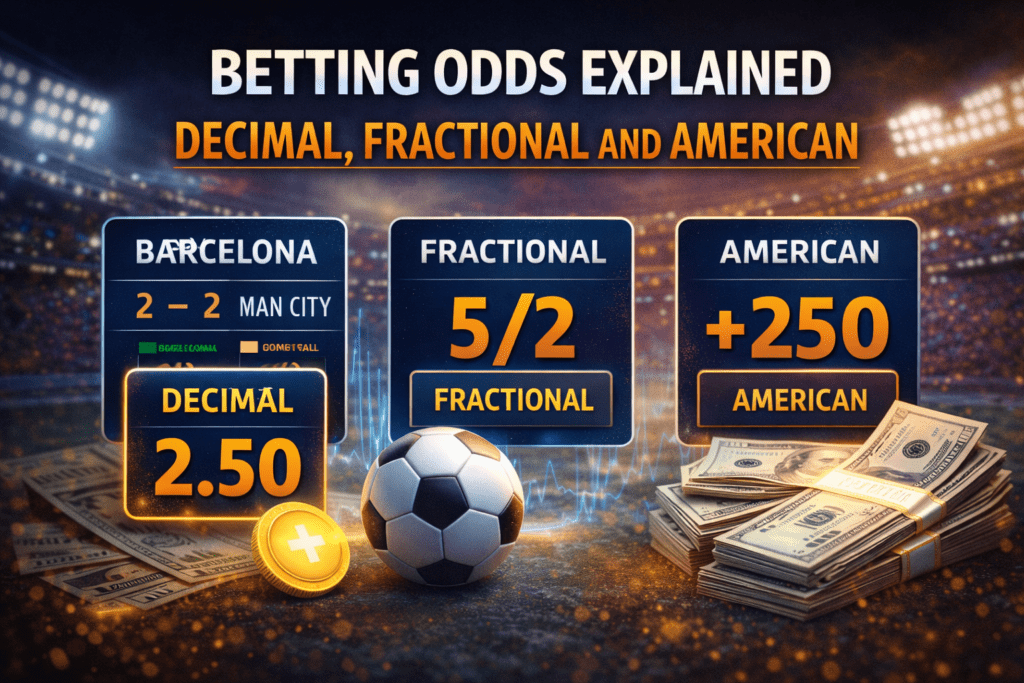
Example comparison for the same outcome:
- Decimal: 2.50
- Fractional: 3/2
- American: +150
Each format results in the same net profit for an equivalent stake. Many experienced bettors mentally convert everything into decimal odds to compare prices more easily.
Which odds format is best for bettors
There is no universally better format. The best option depends on familiarity and the markets you bet on.
Decimal odds are ideal for quick calculations and probability analysis. Fractional odds suit traditional betting environments. American odds are closely tied to US sports culture and clearly distinguish favorites from underdogs.
What matters most is understanding the math behind the odds, not the format itself.
Odds, margins and bookmaker advantage
Odds always include a bookmaker margin, often called the overround or vigorish. This means the combined implied probabilities of all outcomes exceed 100 percent.
For example, in a two-outcome market, the total implied probability might be 105 percent. That extra five percent represents the bookmaker’s edge.
Comparing odds across sportsbooks using trusted comparison platforms helps reduce this margin and improves long-term profitability.
Using odds to bet smarter
Understanding betting odds explained properly allows you to:
- calculate implied probabilities
- spot overpriced or underpriced selections
- avoid betting purely on intuition
- manage risk more effectively
Odds are information. The bettor’s job is to interpret that information better than the market.
Common mistakes when interpreting odds
Many bettors make the same errors repeatedly:
- assuming low odds guarantee a win
- chasing high odds without value
- ignoring bookmaker margins
- failing to compare prices
Avoiding these mistakes is often more important than finding perfect predictions.
Conclusion: odds knowledge is a betting advantage
Understanding betting odds in decimal, fractional and American formats is not optional for serious bettors. Odds define risk, reward and probability, and they shape every betting decision you make.
When you fully understand what odds represent, you stop guessing and start evaluating. Over time, that shift in mindset is what separates losing bettors from disciplined, informed players.
FAQ
Which odds format is easiest for beginners
Decimal odds are generally the easiest because payouts and probabilities are simple to calculate.
Can I change odds format in sportsbooks
Most online bookmakers allow you to switch between decimal, fractional and American formats in account settings.
Do odds change before a match starts
Yes. Odds move based on betting volume, injuries, lineups and new information.
Do odds reflect true probability
Not exactly. They include the bookmaker’s margin and market behavior.
Is understanding odds enough to win consistently
No, but it is essential. Odds knowledge must be combined with analysis, discipline and bankroll management.