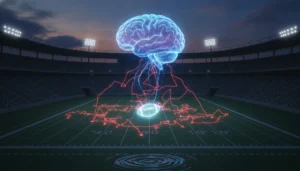

The Punter Who Remembers Every Win and Forgets Half the Losses
Most active punters can recall, in vivid detail, the Saturday they hit a five-team accumulator or the moment they trusted their read on a struggling Arsenal side and it paid off at 3.50. Those moments feel significant because they confirm something: that their judgment is sharp, that their football knowledge translates into an edge.
What the same punter struggles to recall with equal clarity are the fourteen losing slips from the same month. Not because the losses did not happen, but because the brain did not store them with the same weight. This is not a personality flaw. It is a structural feature of how human memory works under variable reward conditions, and it is one of the most costly forces in betting psychology.
How Confirmation Bias Shapes What a Punter Pays Attention To
Confirmation bias is the tendency to seek out and retain information that supports a belief already held, while discounting information that contradicts it. In betting, the belief most punters hold is that they are above-average judges of football outcomes. That belief is reinforced every time a prediction lands and goes largely unchallenged every time one does not.
When a punter backs Manchester City to win and they do, it feels like evidence of reading the game correctly. When City lose, the explanation shifts outward: the referee cost them, a key player was unavailable, the odds were too short anyway. The loss does not register as a failure of analysis. It registers as an external event, something that happened to the bet rather than something the bet got wrong.
Over hundreds of bets, this asymmetry builds a completely distorted self-model. The punter believes they are winning more than they are, or that their losses are mostly bad luck rather than bad judgment. The record in their head bears little resemblance to the record on their betting account.
Selective Memory Turns a Losing Record Into a Winning Narrative
Selective memory operates alongside confirmation bias but works slightly differently. Where confirmation bias filters what a punter engages with in real time, selective memory reshapes what gets retained over weeks and months. Wins are encoded as meaningful events tied to specific reasoning. Losses are processed as noise, as exceptions, as bad variance that does not reflect the underlying strategy.
A punter who has placed three bets per day for six months has made around five hundred betting decisions. If asked to assess their strike rate honestly, most would estimate significantly higher than their actual return rate — not because they are being dishonest, but because the wins have been rehearsed mentally far more often than the losses. The result is that punters continue using approaches that are not working, because their memory of those approaches is systematically skewed toward the times they did work.
The Specific Decisions That Distorted Self-Assessment Produces
Stake Creep and the Illusion of a Hot Streak
When a punter lands two or three wins in quick succession, those results feel like confirmation of sharpened form. The rational interpretation would be to maintain the same stake and recognise that variance naturally produces clusters of positive results. The emotional interpretation, reinforced by memory bias, is that something real is happening.
So the stakes go up — not dramatically, often not even consciously. If the next bet loses, it is absorbed as the streak ending rather than evidence that the streak was statistical noise. If it wins, the cycle continues. What this produces over time is a pattern where the punter is routinely staking more during periods they have misread as skill-based runs, and the overall return suffers accordingly.
How Confirmation Bias Corrupts Pre-Match Research
The distortion also shapes how a punter processes information before placing a bet. Once an initial opinion is formed — say, that the home side is due a win after a run of draws — confirmation bias begins filtering the research process itself. Statistics that support the conclusion get noticed and weighted heavily. Statistics that cut against it receive less attention or are rationalised away.
The punter finishes their research feeling more confident than when they started, which is exactly the wrong outcome if the process has been compromised from the beginning. True research should occasionally change a punter’s mind. When it consistently confirms the original view, that is almost always a sign that confirmation bias has done most of the work, not analysis.
The Role of Social Reinforcement in Deepening the Bias
Betting in social contexts — WhatsApp groups, tipster forums, conversations among friends — adds another layer to an already distorted self-assessment. These environments operate as echo chambers where confirmation bias is shared and amplified. When a punter posts a winning pick, the responses are enthusiastic. When the prediction misses, the conversation moves on quickly.
There is also the pressure of following a shared consensus. When multiple people back the same selection, each individual interprets that agreement as additional evidence the pick is sound. In reality, if everyone in the group carries the same biases and follows similar sources, the consensus reflects shared distortion rather than independent analysis.
- Wins shared publicly in betting groups are recalled and referenced repeatedly in future conversations
- Losses rarely attract the same sustained discussion or honest post-mortem analysis
- Tipster reputations inside these communities are built almost entirely on the selective recall of successful predictions
- Punters who challenge a group consensus are often marginalised, suppressing the critical thinking that might correct biased reasoning
Social betting environments, despite feeling like they offer collective wisdom, often function as engines for reinforcing the same biases each individual punter already carries privately. The group does not correct the distortion. It organises around it.
Breaking the Loop Requires More Than Willpower
The uncomfortable truth about confirmation bias and selective memory is that recognising them intellectually does almost nothing to neutralise them in practice. A punter can read everything written about cognitive distortion in betting and then repeat every pattern described here almost exactly on a Saturday afternoon. These biases operate below the level of conscious decision-making. They are structural tendencies in how the brain processes reward, risk, and self-image.
Correcting them requires structural solutions rather than mental resolve. The single most effective intervention is external record-keeping that the punter cannot later revise in their own favour — a complete, unedited log of every bet placed, the reasoning recorded before the result is known, the stake, the outcome, and the running return on investment calculated honestly across the full sample. When a punter is forced to read that record rather than rely on memory, the distorted self-narrative becomes very difficult to sustain.
Pre-commitment rules serve a similar function. Deciding in advance that stakes will not increase following consecutive wins removes the mechanism by which stake creep operates. Requiring that at least one credible counter-argument be written down before a bet is placed creates friction in the confirmation bias cycle, forcing genuine engagement with disconfirming evidence. For punters in social betting communities, the harder discipline is learning to treat group consensus as something worth scrutinising rather than following. When everyone agrees, the question worth asking is not whether they are right, but whether anyone has genuinely tested the opposite position.
None of this eliminates variance, and none of it guarantees profit. What it does is ensure that the punter’s self-assessment more closely reflects reality — that wins and losses are counted with equal weight and that the story told about past performance is built on an accurate record rather than a selectively edited one. Understanding when patterns of thinking around gambling have become harmful is a meaningful step that sits alongside any practical adjustments to betting behaviour.
The punter who remembers every win and forgets half the losses is not weak or dishonest. They are human, operating exactly as human cognition is designed to operate under variable reward conditions. The edge, if there is one to be found, belongs to the rare few who build systems that hold them accountable to the record the brain would rather quietly revise.